Recipe costing: work out the cost of every plate
Recipe costing adds up every ingredient in a dish at today's prices. Build it right, keep it current, and let it guide your menu decisions.
SyncOn team · 21 Oct 2026 · 3 min read
Ask a restaurant owner what their best seller costs to make and the answer is often a round number from memory. It was right once, maybe when the menu was printed. Since then the chicken price has moved twice, the sauce recipe changed, and the bread comes from a new supplier. Recipe costing is the habit of working that number out properly, from the recipe, at today's prices.
Why it matters
Every decision about a dish depends on its cost: its price, its portion, whether it stays on the menu. If the cost is a guess, every one of those decisions is a guess too.
Recipe costing is simple arithmetic, but it has to be complete. For each ingredient in one portion, multiply the quantity by its current price per gram, per millilitre or per piece. Add them all up, and that is the cost of the plate. The common mistakes are not in the maths. They are in what gets left out: the sauce made in-house, the oil for frying, the bread on the side, the packaging for delivery.
The other mistake is time. A recipe costed once and never again slowly becomes fiction, because ingredient prices move every month.
A third mistake is costing the dish as it is planned rather than as it is made. If the recipe says one portion of rice but the cooks serve a little more, the costing is right on paper and wrong on the plate. Recipe costing and portion control work as a pair: one says what the dish should cost, the other makes sure it does.
What good practice looks like
- Cost from the written recipe. Recipe costing only works when the recipe lists every ingredient and its quantity. Start with a standardized recipe for each dish.
- Include the prep items. Sauces, marinades and doughs made in-house have a cost per gram too. Work it out from their own batch and its recipe yield, then use it in every dish that contains them.
- Don't forget the small things. Frying oil, garnish, bread, and for delivery, the box and the cup. Small amounts on every plate add up over a month.
- Use current prices. Take the price you actually paid most recently, not the price from the first order.
- Re-cost on a schedule. Monthly at least, and immediately after a big price change from a supplier.
- Turn it into a decision. Compare each dish's cost with its selling price to see how to calculate food cost as a percentage, then act on the dishes where that share is too high.
A costing sheet on paper or in a spreadsheet works, as long as somebody owns it and updates it. The danger is the sheet that was made once, saved in a folder, and never opened again.
How this looks in SyncOn
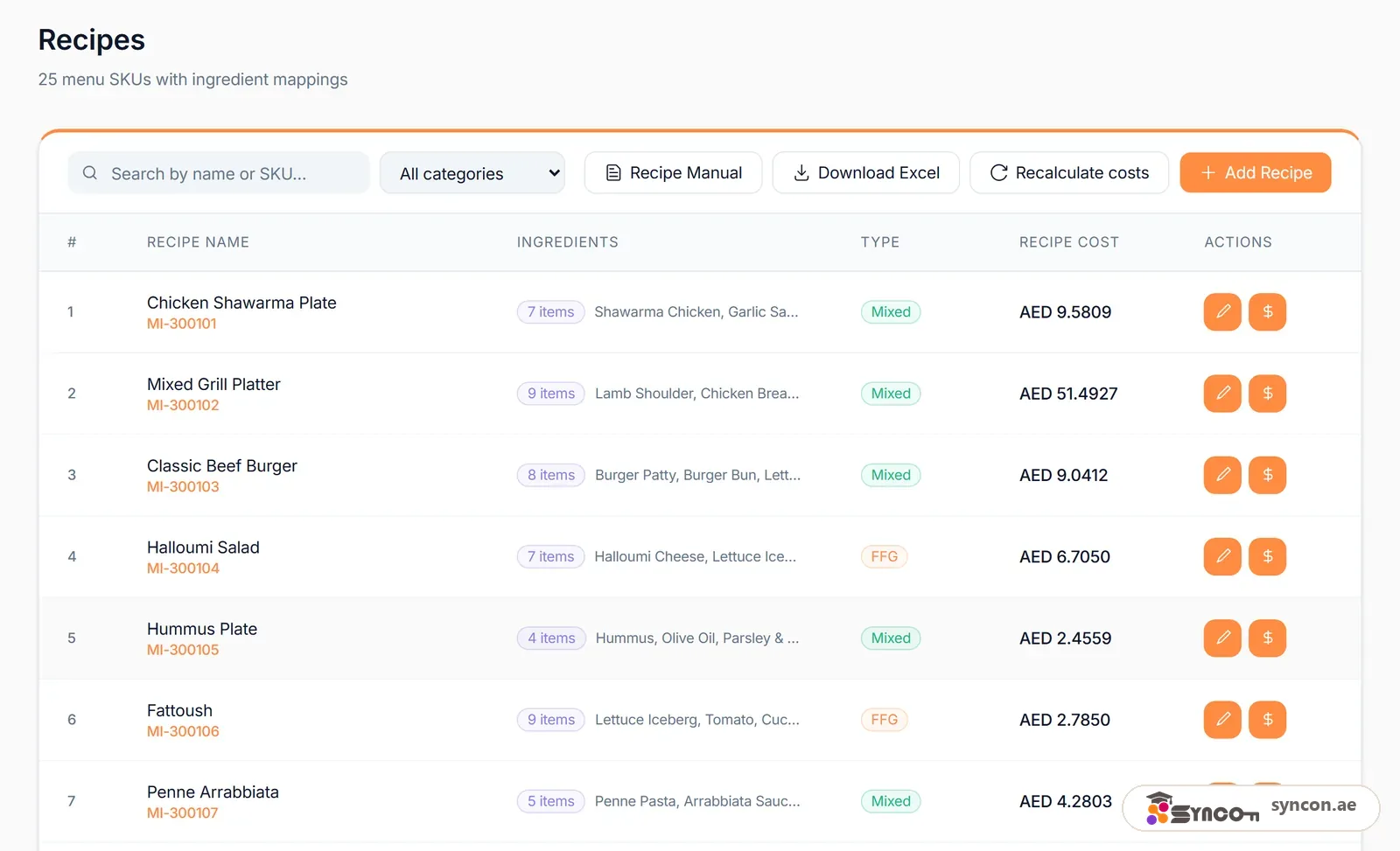
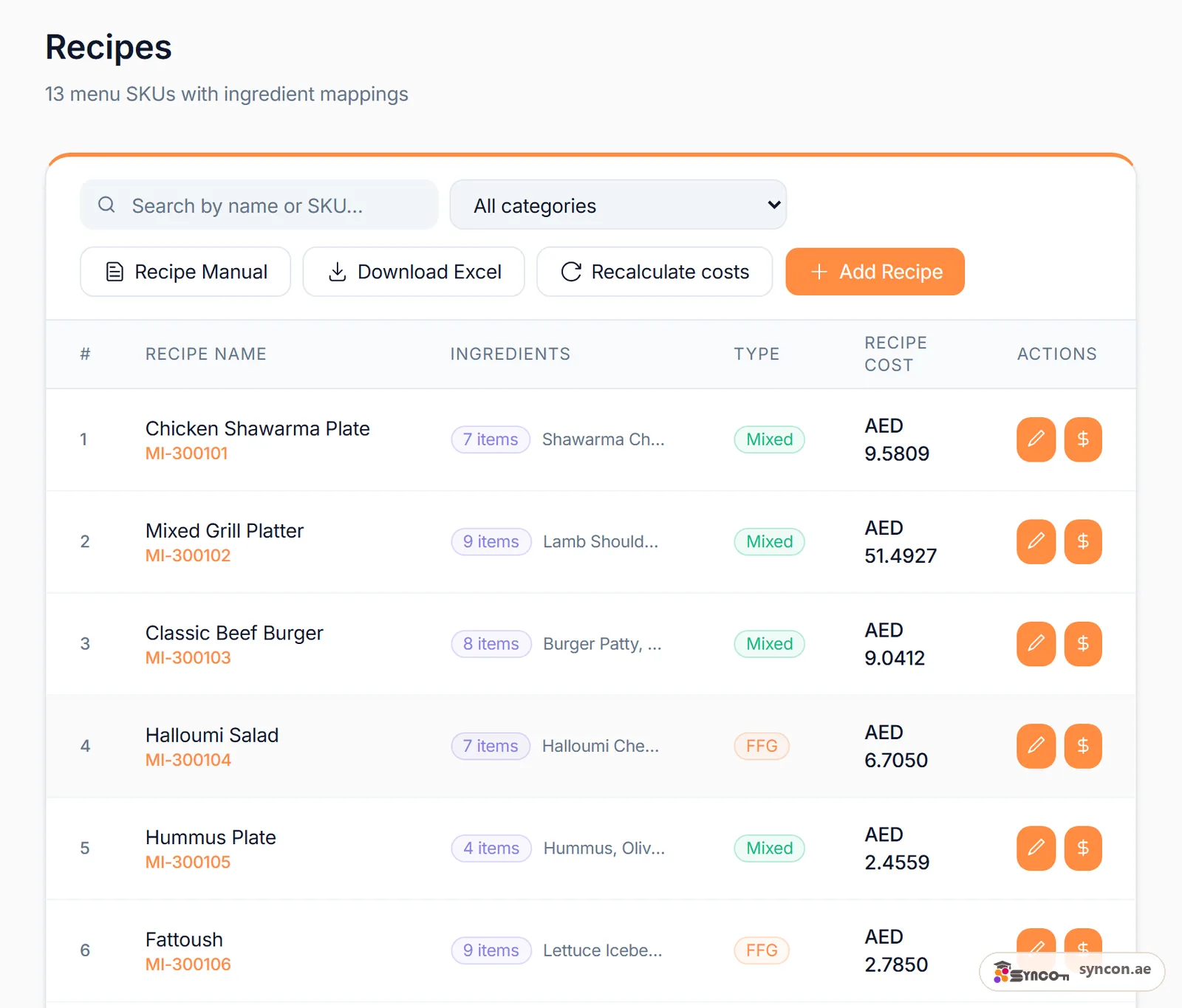
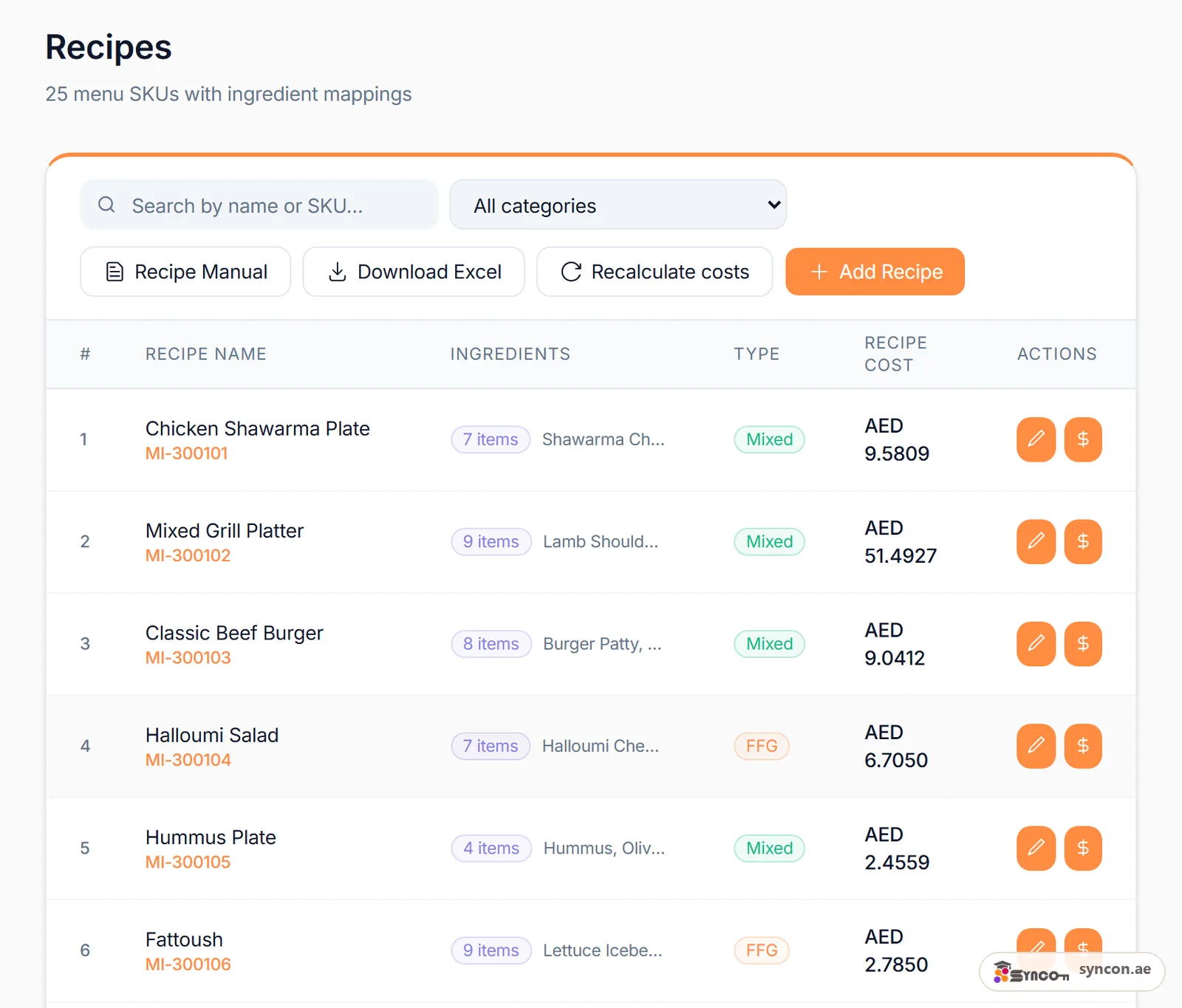
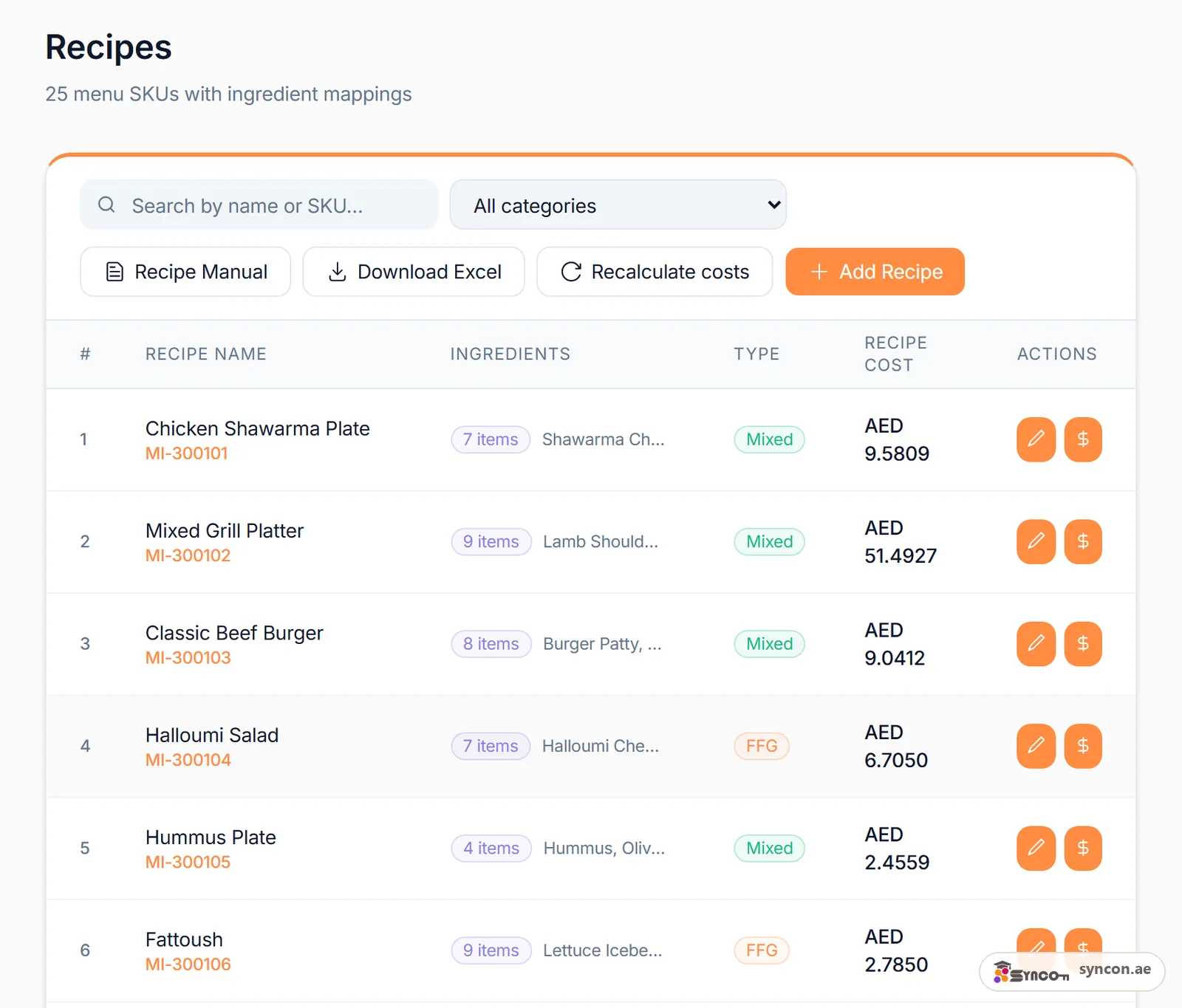
Here the recipe costing is done from the recipes themselves. Each dish's cost is the sum of its ingredients at their current prices, prep items included, and it sits next to the dish in the recipe list. In the demo kitchen the chicken shawarma plate costs AED 9.58, the mixed grill platter AED 51.49, the halloumi salad AED 6.71 and the hummus plate AED 2.46. The Recalculate costs button brings every dish up to date after ingredient prices change, so the costing never goes stale.
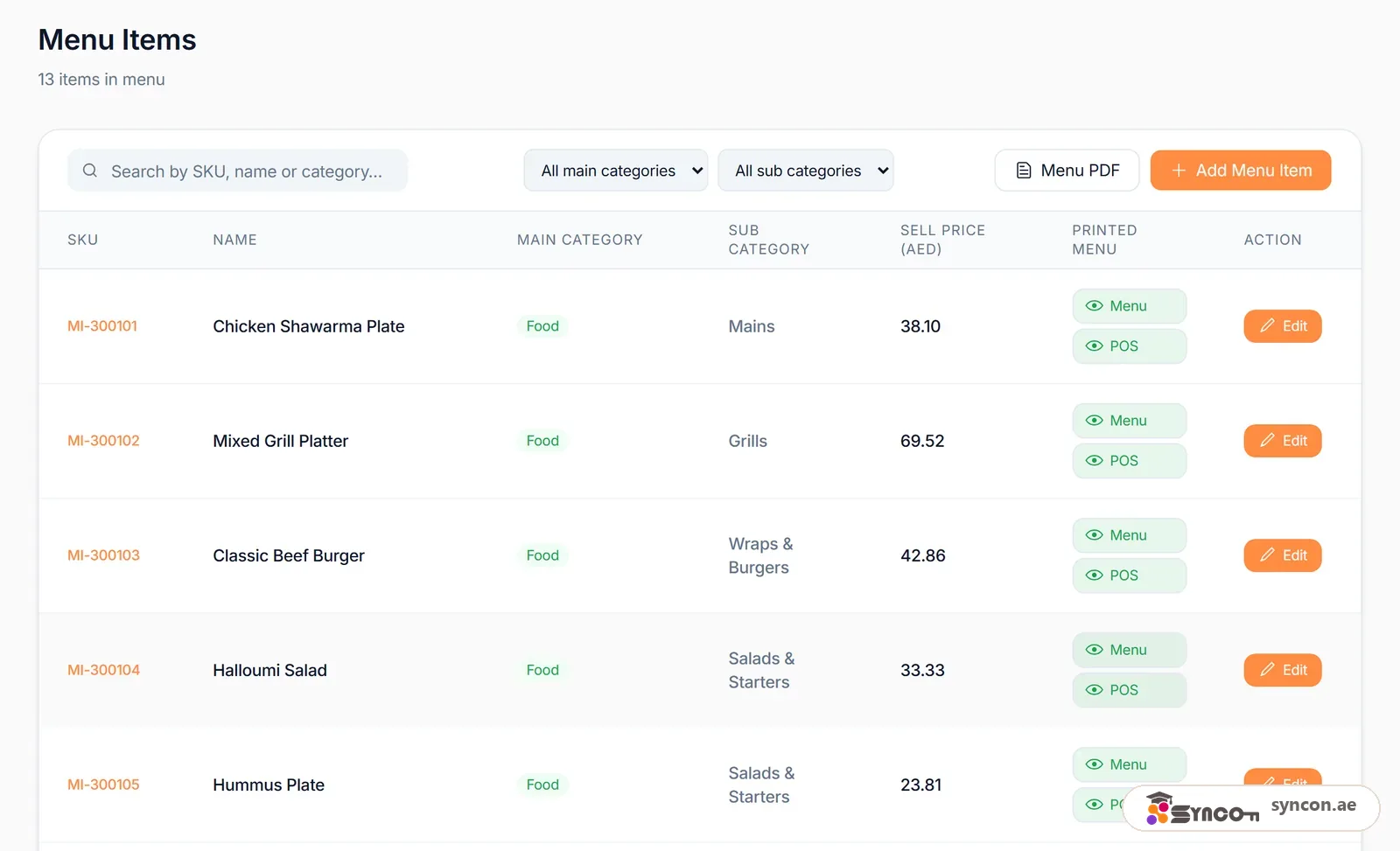
The selling prices sit with the menu items, ready to be read against the costs. The halloumi salad sells for AED 33.33 against its cost of AED 6.71, which leaves AED 26.62 on each plate. The same comparison can be made for every dish on the list, and repeated each time the costs are recalculated.
Learn the full method in الوصفات والتكلفة والتشغيل اليومي.
The screens above are from
Restaurant operating systemsyncon.ae/portfolio/operating-system(opens in a new tab)