How to calculate food cost for every dish
How to calculate food cost for every dish, as a cost and as a percentage of its price, and how to spot the dishes quietly losing money.
SyncOn team · 21 Oct 2026 · 4 min read
A busy Thursday ends with a long queue at the pass and a strong number on the sales report. Everyone goes home happy. A month later the accounts say the kitchen made less than it should have, and nobody can point to why. The sales were real. What nobody could see was how much of each sale went straight back out as ingredients. Knowing how to calculate food cost for each dish is how you see it.
Why it matters
Food cost is the share of a dish's selling price that you spend on the ingredients to make it. To calculate it, add up the cost of every ingredient in one portion, divide by the selling price, and multiply by a hundred to get the food cost percentage. If a plate sells for a certain price and its ingredients cost a quarter of that, the other three quarters are left to pay for staff, rent, gas, packaging and, at the end, profit.
Most kitchens know their food cost only as one average for the whole month. The average hides the real story. A menu can look healthy overall while one or two popular dishes cost almost as much to make as they sell for. Those dishes keep the kitchen busy and the team proud, and they quietly eat the margin that the cheaper dishes earn.
The only way to see this is to work out the food cost of each dish on its own. Once you can see it per plate, the decisions become simple: which dish needs a smaller portion, which needs a new price, and which is fine as it is.
What good practice looks like
- Start from the recipe. A dish's cost is the sum of each ingredient's quantity times its current price. Without a written recipe there is nothing to calculate, only a guess, so start with a standardized recipe for each dish.
- Use today's prices. Supplier prices move. A cost worked out last year tells you about last year. Recipe costing shows how to build each dish's cost step by step.
- Divide by the price you actually keep. Use the selling price before tax, so the share you calculate matches the money that reaches the business.
- Look at every dish, not only the average. Sort the menu from the highest food cost to the lowest and read the top of the list first.
- Ask why before you act. A high share is not always wrong. A signature dish with expensive meat can carry a higher share if it sells well and brings guests back. A side dish with a high share usually just needs a smaller portion or a better price. The menu engineering matrix helps you weigh each dish's cost against how well it sells.
- Check again after every change. A new supplier, a new portion or a new price changes the number. Make the check a weekly habit rather than a yearly project.
There is no single right food cost for every dish. What matters is that you know each one, and that every high number is a decision, not an accident.
How this looks in SyncOn
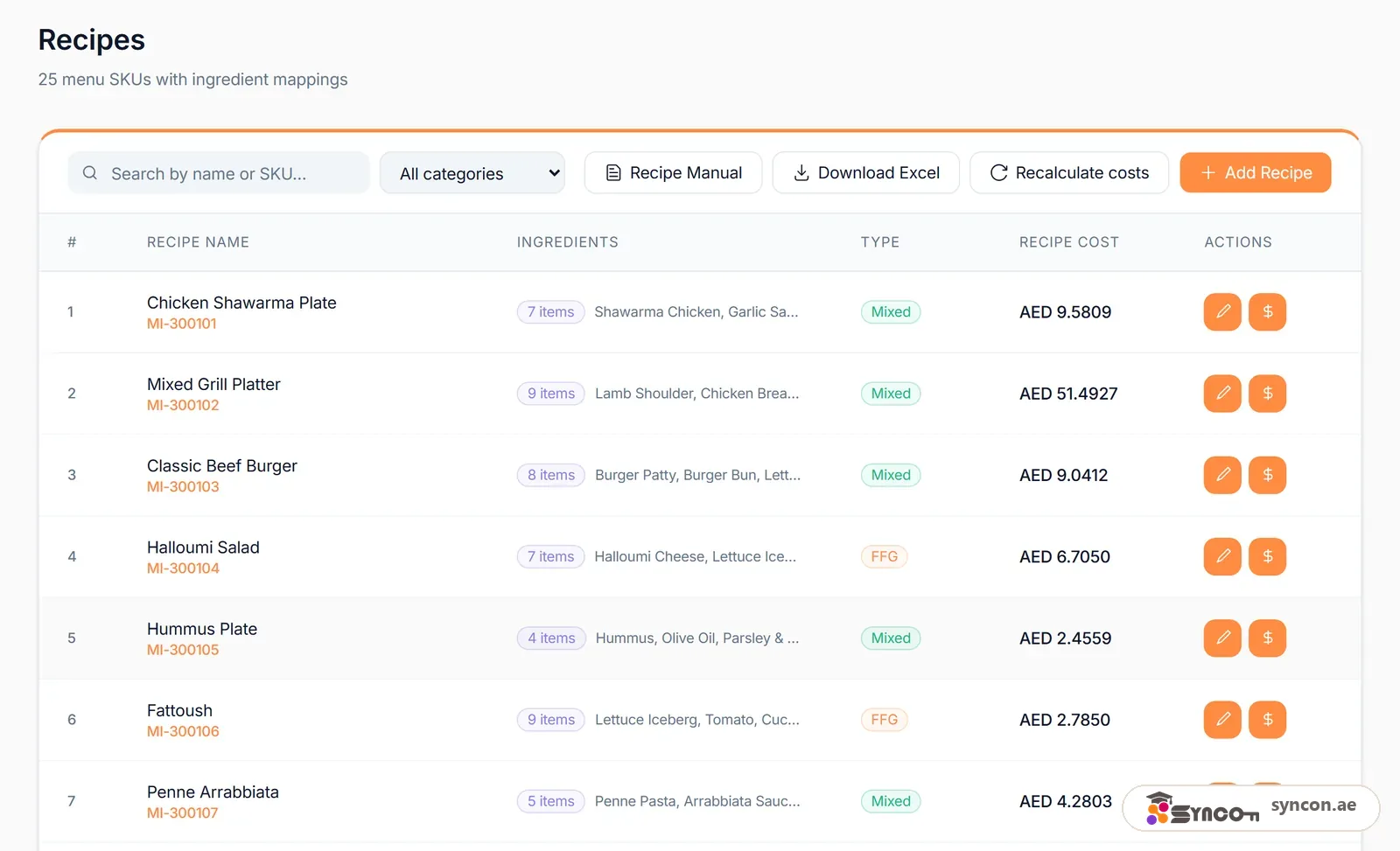
Every dish's cost comes straight from its recipe and the current ingredient prices. In the demo kitchen the chicken shawarma plate costs AED 9.58 to make, the mixed grill platter AED 51.49, the classic beef burger AED 9.04 and the hummus plate AED 2.46. When ingredient prices change, the Recalculate costs button brings every dish up to date.
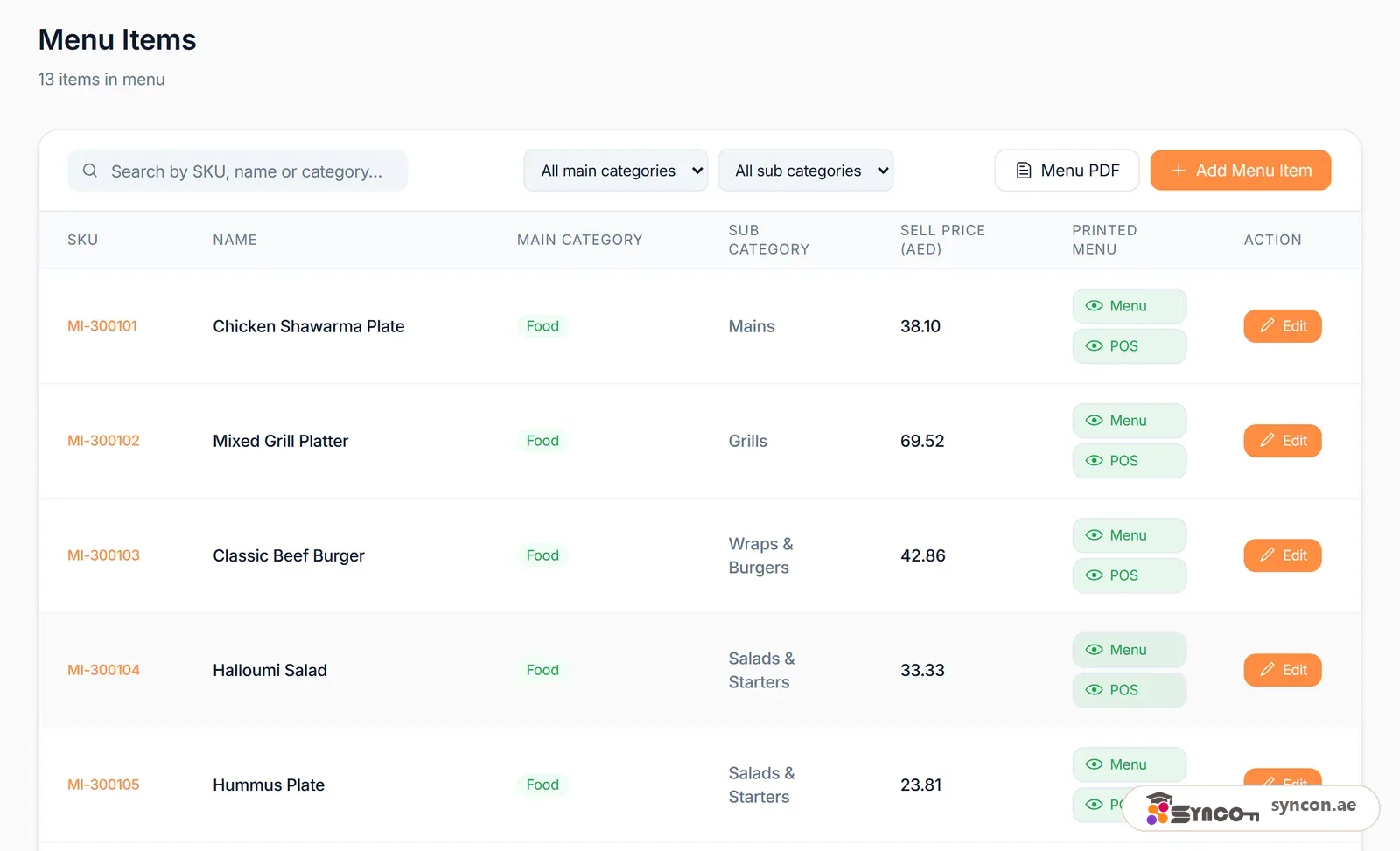
The selling prices sit with the menu items. Put the two screens side by side and the food cost of each dish appears. The chicken shawarma plate sells for AED 38.10 against its cost of AED 9.58, a food cost of 25.1%, leaving AED 28.52 on every plate. The hummus plate sells for AED 23.81 against AED 2.46, just 10.3%. The mixed grill platter tells a different story: it sells for AED 69.52 and costs AED 51.49, a food cost of 74.1%, which leaves only AED 18.03 per platter to cover everything else.
That one line is the point of the exercise. The platter may be a favourite, but at this cost it needs a decision: a smaller portion of the most expensive meat, a new price, or a conscious choice to keep it as it is because of what it does for the table.
Learn the full method in الوصفات والتكلفة والتشغيل اليومي.
The screens above are from
Restaurant operating systemsyncon.ae/portfolio/operating-system(opens in a new tab)