Menu engineering matrix: what to do with each dish
Use the menu engineering matrix to sort dishes by margin and sales into stars, workhorses, puzzles and dogs, and act on each group.
SyncOn team · 21 Oct 2026 · 4 min read
At Sunday's menu print meeting, the head chef wants to keep all 13 items on the menu because every dish has a regular guest who orders it, while prep tables stay crowded and the walk-in chiller is full. A dish that stays on the menu out of habit still takes up prep hours, fridge space and cash tied up in ingredients. The menu engineering matrix sorts every dish by two facts—its margin and how many plates it sells—into four clear groups so you can decide what to protect, re-price, promote or cut.
In short
- Pull one full month of plates sold and margin percentage for every dish inside the same category.
- Place each dish into one of four groups: Star, Workhorse, Puzzle or Dog.
- Take the matching action for each group, changing one price, recipe or menu spot at a time.
Why margin and sales belong together
Looking at margin and plates sold together stops you from cutting a popular dish or promoting a slow one that barely covers its ingredients. A busy dining room can still leave very little money behind if the busiest platters carry a thin margin. Margin is the percentage of a dish's selling price left after paying for its recipe ingredients, which comes from knowing how to calculate food cost for each plate. The sales side comes from your sales mix, which counts how many plates each dish sold over the period.
When you cross those two numbers, every dish lands in one of four groups:
- Star (High Margin + High Sales): a dish that guests order often and that leaves a strong share of its selling price after ingredient cost, so you protect its recipe and portion.
- Workhorse (Low Margin + High Sales): a crowd favourite that keeps the line busy but leaves a smaller share per plate, so you tighten its recipe or test a careful price move.
- Puzzle (High Margin + Low Sales): a dish that leaves a strong margin whenever it sells but isn't ordered enough, so you help guests notice and choose it.
- Dog (Low Margin + Low Sales): a dish that neither sells well nor leaves much margin per plate, making it the first candidate to rework or remove from the menu.
How to run a monthly review
Run your review once a month by comparing dishes within their own category and acting on one group at a time.
Start by pulling at least a full month of sales and current recipe margins so a single busy weekend does not skew the picture. Compare mains against mains and cold drinks against cold drinks, because a coffee and a platter do not compete for the same appetite.
Lock down your Stars first. Keep their recipes, ingredient quality and portion weights steady on every shift, and give them prime visual spots on your printed and digital menus.
Next, look closely at the Workhorses. Because guests already order them in volume, do not drop them from the menu. Check whether an expensive garnish can be trimmed or whether the selling price can move slightly; read how to price menu items before changing a popular dish.
For Puzzles, test one change that helps the dish sell more plates: a clearer name, a better description, or asking the service team to suggest it at the table. For Dogs, check if the ingredients are only bought for that dish; if so, removing it frees prep time and shelf space right away.
How this looks in SyncOn
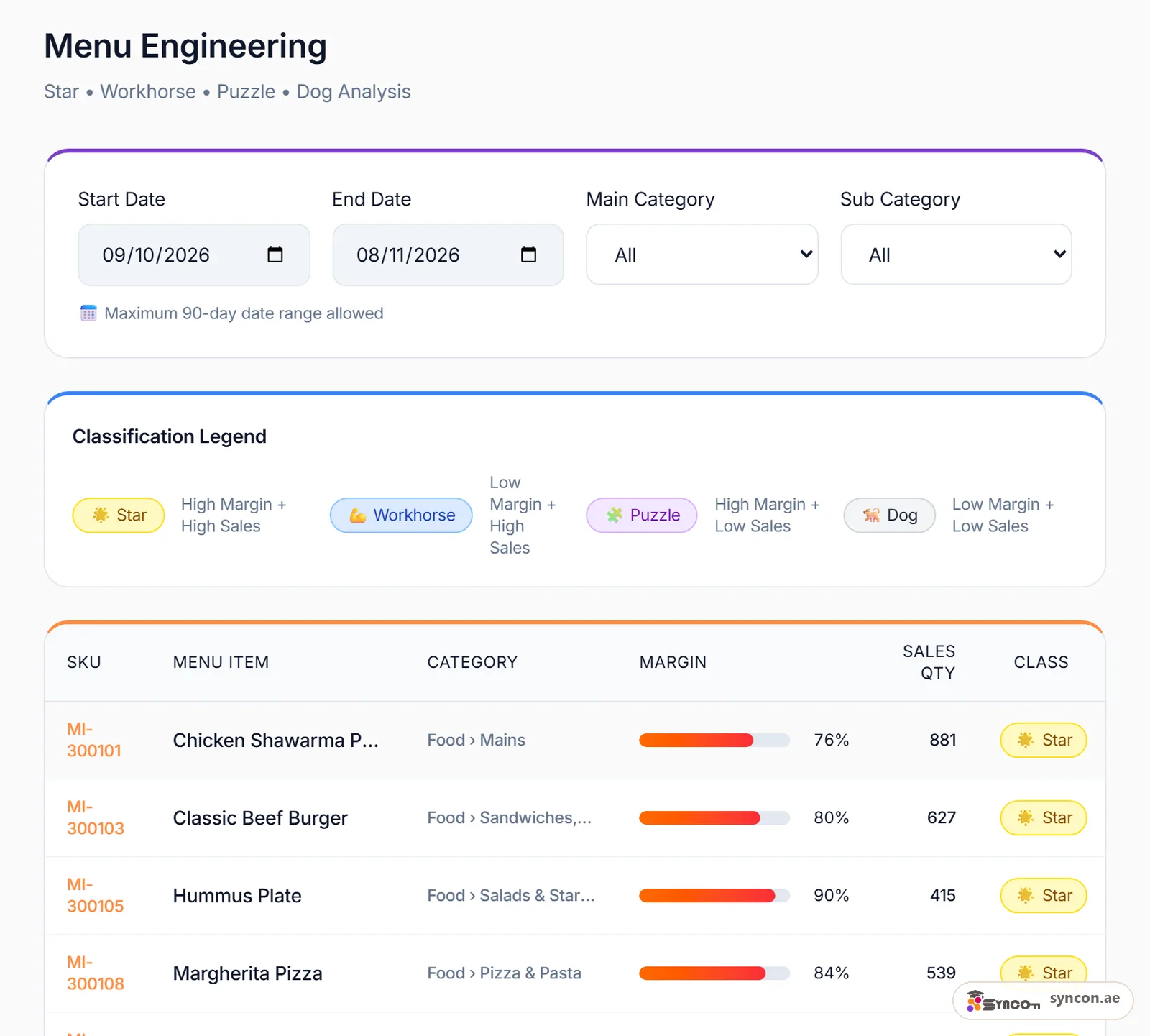
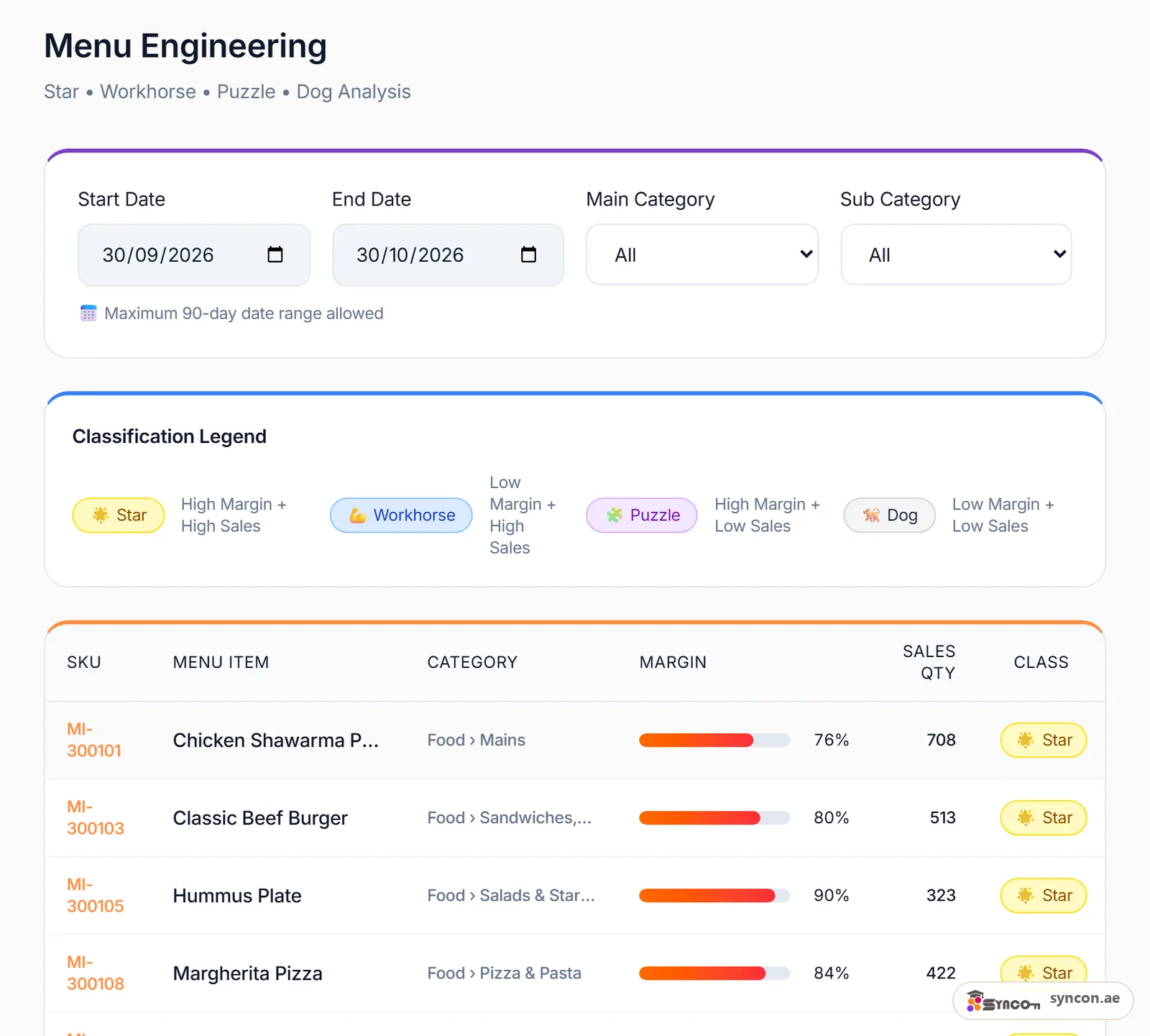
The Menu Engineering screen shows each dish's category, margin percentage, sales quantity and class across a chosen date range of up to 90 days.
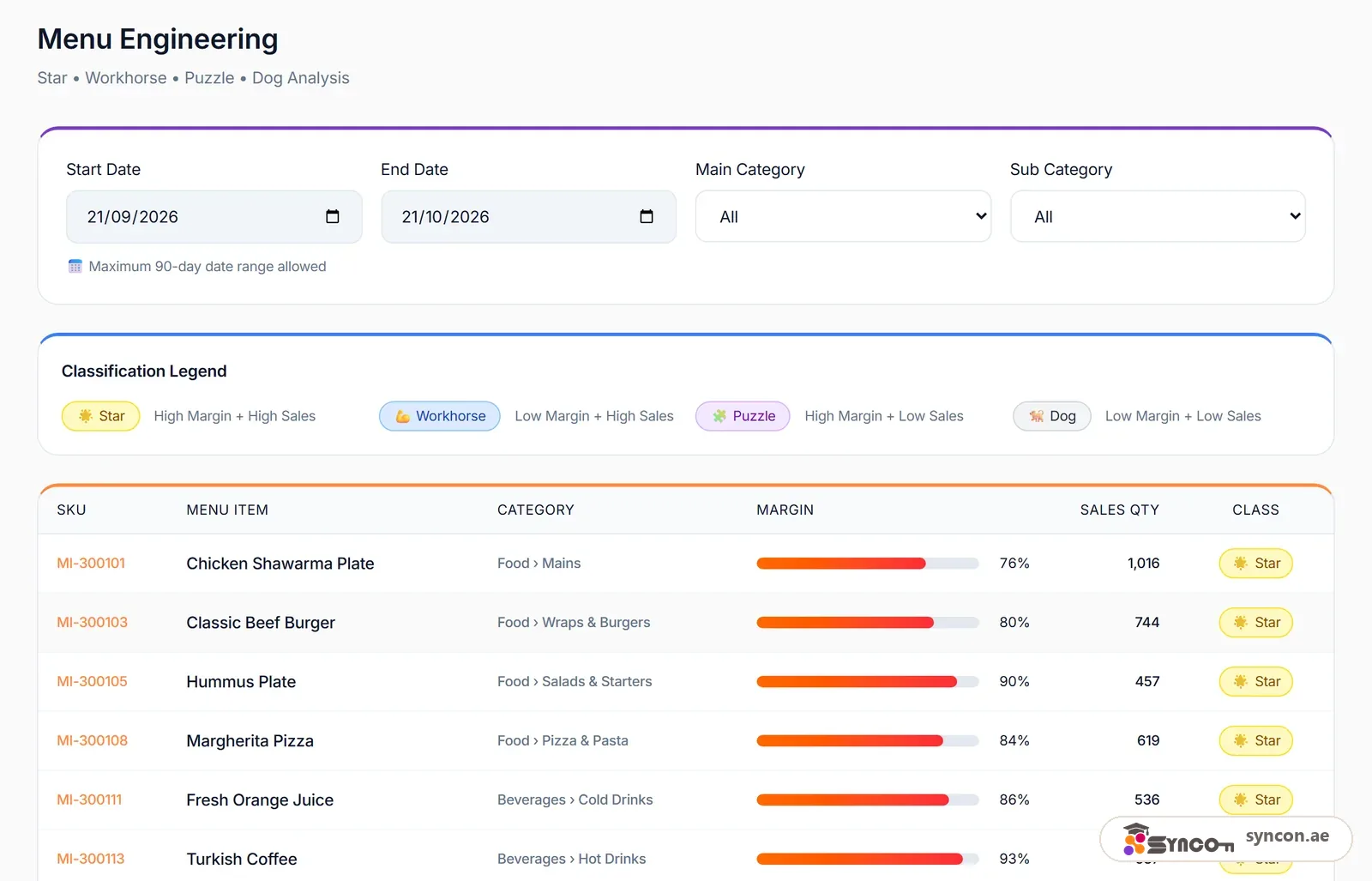
In the demo kitchen, from 21 September 2026 to 21 October 2026 across all 13 items, 6 dishes land in the Star group, 1 is a Workhorse, 5 are Puzzles and 1 is a Dog. You can filter by Main Category or Sub Category at the top to compare neighbours fairly, or read the top Stars directly from the list:
- Chicken Shawarma Plate: 76% margin and 1,016 plates sold (Star).
- Classic Beef Burger: 80% margin and 744 plates sold (Star).
- Margherita Pizza: 84% margin and 619 plates sold (Star).
- Turkish Coffee: 93% margin and 537 plates sold (Star).
- Fresh Orange Juice: 86% margin and 536 plates sold (Star).
- Hummus Plate: 90% margin and 457 plates sold (Star).
Further down the table, the Mixed Grill Platter sells 775 plates at a 29% margin, putting it in the Workhorse group, while Lamb Ouzi sells 122 plates at a 25% margin as a Dog. Meanwhile, Halloumi Salad sits in the Puzzle group with an 81% margin and 152 plates sold.
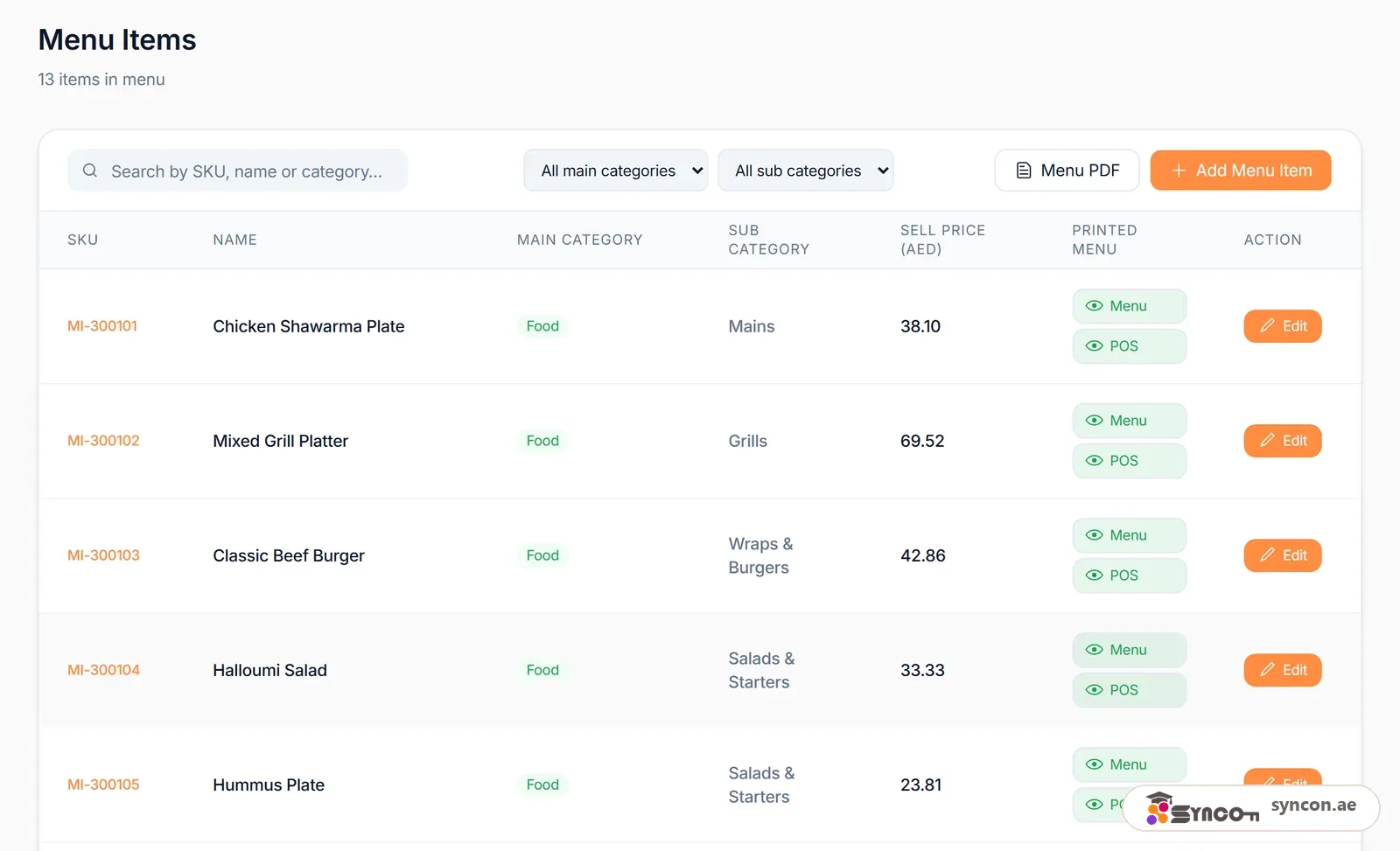
The Menu Items screen shows the selling price in AED, the category and the Edit button for all 13 items in the menu. Here the Mixed Grill Platter sells at AED 69.52 and the Classic Beef Burger sells at AED 42.86.
Across 775 plates sold at AED 69.52, the Mixed Grill Platter brings in AED 53,878 in sales over the month, yet it sits at a thin 29% margin. Clicking Edit on a Workhorse or Puzzle lets you update its selling price and check next month's report to see if the dish moved into the Star group.
Learn the full method in التقارير والتخطيط والنمو.
The screens above are from
Restaurant operating systemsyncon.ae/portfolio/operating-system(opens in a new tab)