Food delivery profit margin: what each order earns
Delivery orders are growing, but each one earns less. Work out your food delivery profit margin dish by dish, before the month ends.
SyncOn team · 23 Oct 2026 · 4 min read
The tablet by the pass keeps beeping. Delivery orders come in all evening, the drivers queue at the door, and the night feels busy. Then the month closes and the money doesn't match the noise. That gap is your food delivery profit margin, and for many UAE kitchens this year it is thinner than it looks from the kitchen.
Delivery is growing, but each order earns less
The shift is real. Delivery orders in the UAE rose 17% this summer while dine-in orders fell 12%, and a delivery order brings in roughly 30% less at the till than a dine-in order, according to restaurant transaction data reported by Khaleej Times on 2 October.
Then the app takes its share. One vendor's blog says UAE owners report paying 25 to 35% commission per order, per Horex. That range comes from a company selling to restaurants, so treat it as rough and check your own contract.
Put together, more of your orders now come through the channel that keeps the least of each one. More volume doesn't fix that. It can hide it.
Where the money goes on a delivery order
A dine-in plate has two big costs: the food and the people. A delivery order adds more on top, and several of them are easy to forget:
- The price uplift. Most kitchens list dishes a little higher on the app. It helps, but it rarely covers everything below.
- The app promotion. When you join a campaign, the customer pays less and you receive less. The price cut comes off before the commission is worked out.
- The commission and fees. Charged as a percentage of what the customer pays, and that amount includes VAT.
- The VAT. It sits inside what the customer pays, but it was never your money.
- The packaging. Boxes, lids, bags and cutlery, on every single order.
How to work it out, dish by dish
You can do this on paper for your top dishes. Do it per dish, never as one average for the whole menu.
- Start from the price on the app, with VAT.
- Take off the promotion if you run one. That is what the customer pays.
- Take out the VAT inside that amount.
- Take off the commission and fees, worked out on what the customer pays.
- Take off the food cost and the packaging. If you need the food cost first, see how to cost a recipe line by line.
- What is left is the margin on that dish. Sort your dishes by it, smallest first.
Expect surprises. The dishes that sell for the most often carry expensive ingredients, and a percentage charge on a big ticket takes a big bite. A dish can be your best earner in the dining room and lose money on the app.
How this looks in SyncOn
The Aggregator Plan in SyncOn does this calculation for every dish on a channel at once. You enter the channel terms: how much higher your app prices are, any campaign promotion, and each charge on your statement.
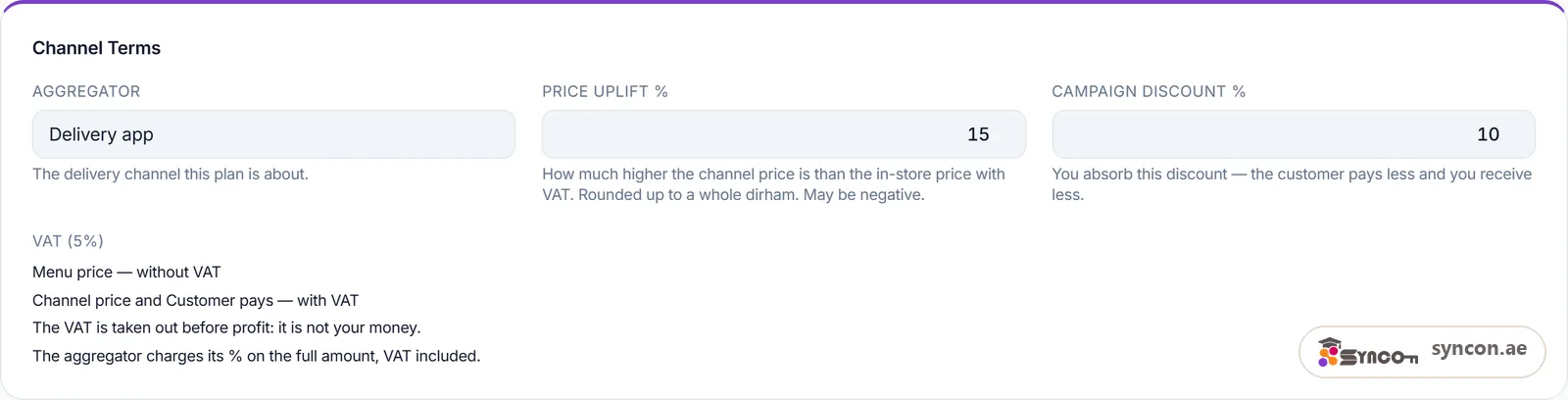
For this example, the demo kitchen was given a 15% price uplift, a 10% campaign promotion and one 30% commission line on a channel simply called "Delivery app". Then five dishes were picked, with the units expected for the month.
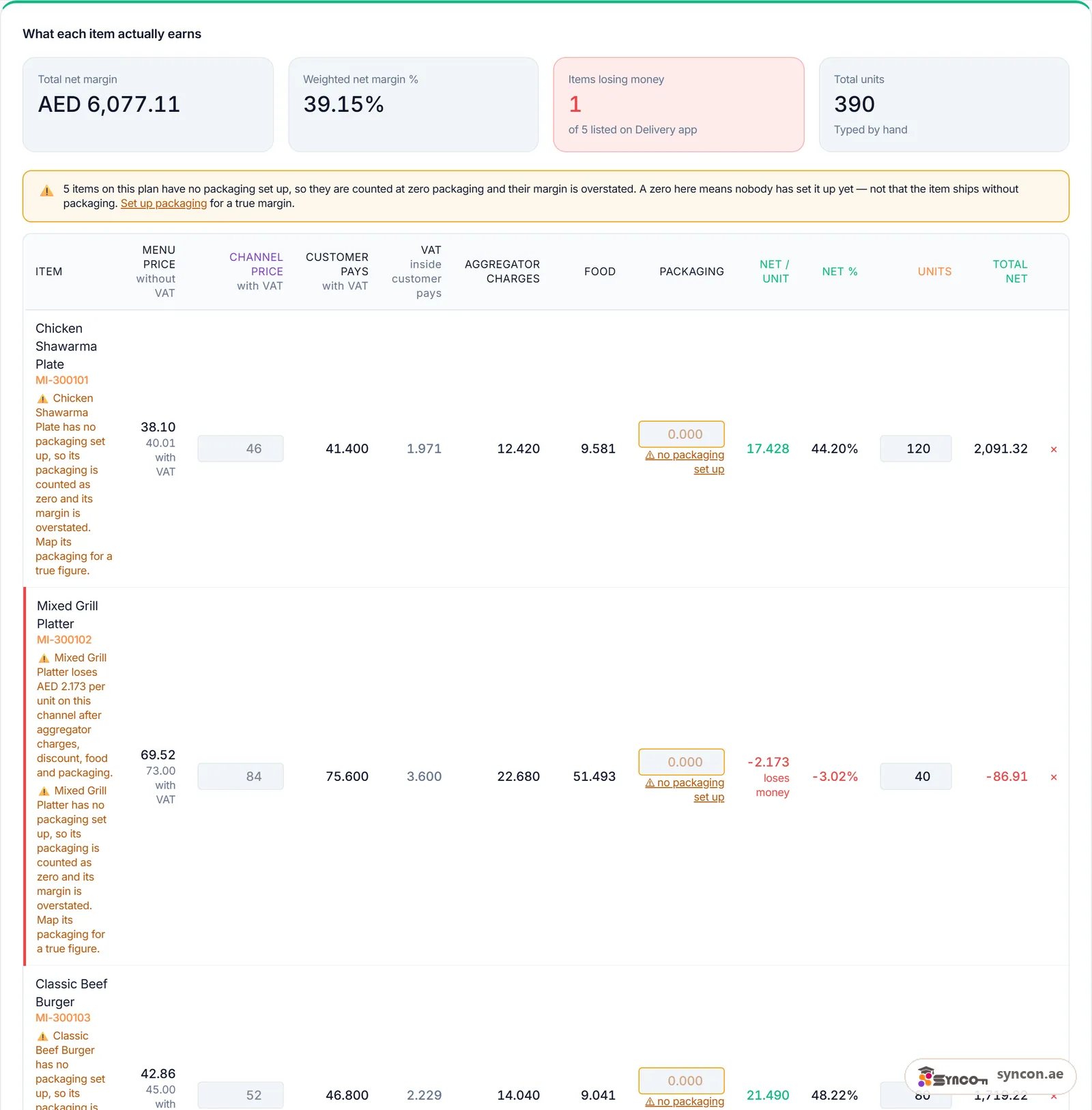
Look at the Mixed Grill Platter. Its menu price is AED 69.52, it lists 15% higher on the app, and after the promotion the customer pays AED 75.60. The VAT inside that is AED 3.60, the commission takes AED 22.68 and the food costs AED 51.49. That leaves a loss of AED 2.17 on every platter sent out, the most expensive dish on the plan and the only one losing money.
The Chicken Shawarma Plate on the same terms keeps AED 17.43 per order. Same channel, same commission, a very different result, because its food cost is far lower than its price.
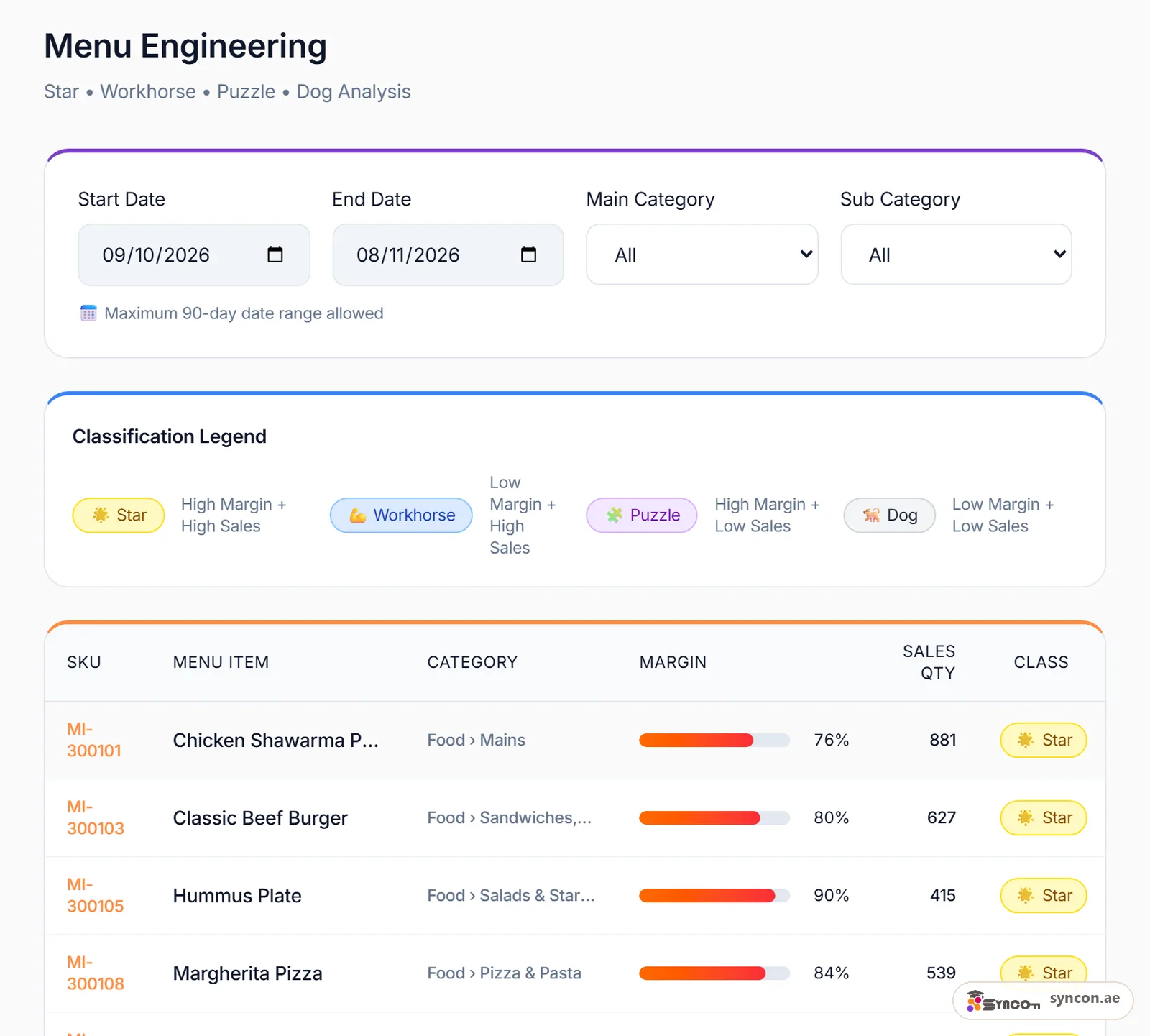
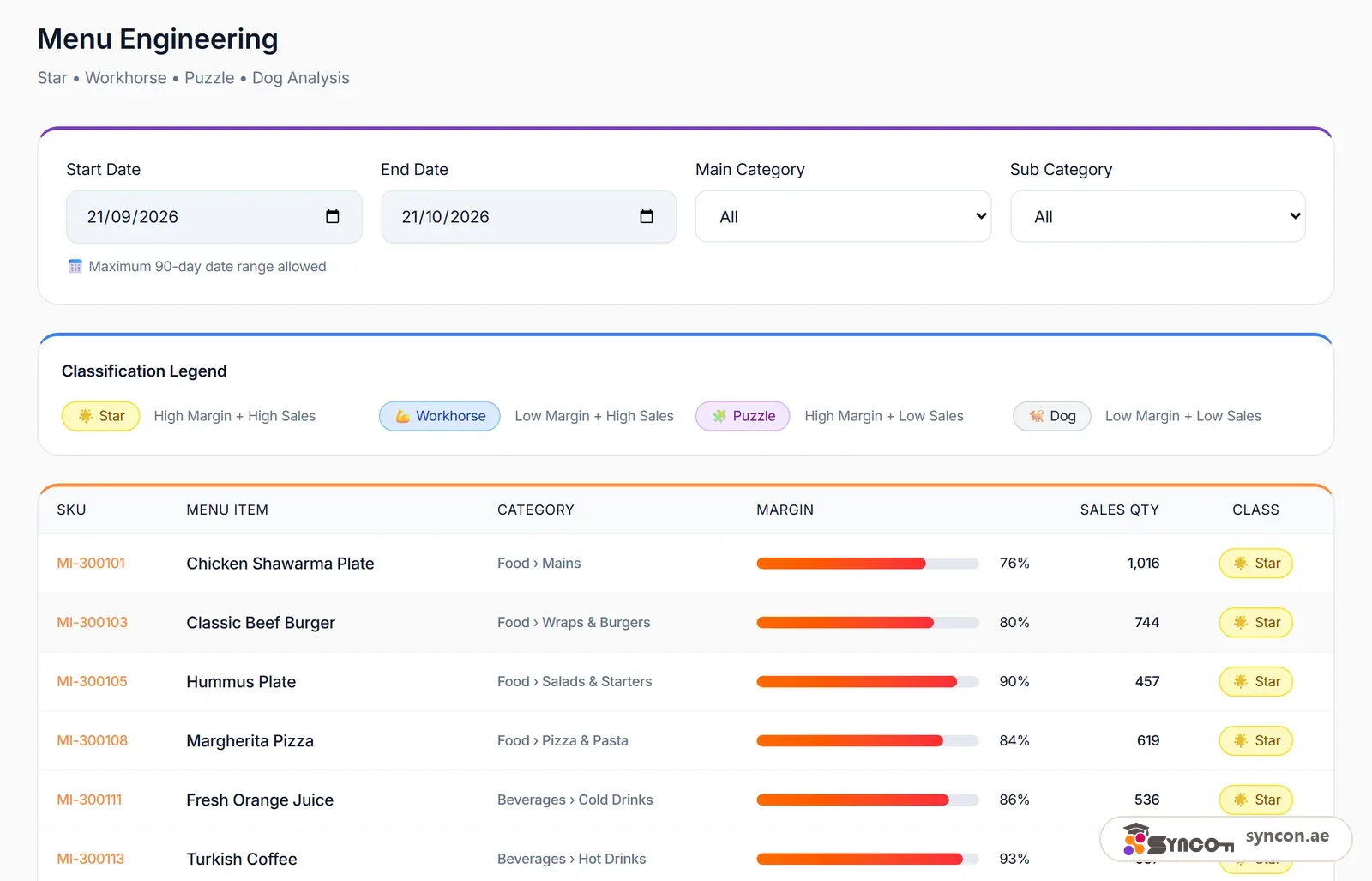
The page also flags that none of these dishes has packaging set up yet, so every margin shown is still a little too high. Adding the box and bag cost for each dish makes the figure true. From there the choices are clear: raise the app price of the platter, change its portion for delivery, leave it out of app promotions, or take it off the app. For the wider view of which dishes deserve their place, see the menu engineering matrix.
Once the plan is saved, Download PDF turns it into a branded report, so the same figures can go to a partner or the accountant. Approving the plan seals them, and a copy can be made later when the app's terms change.
Learn the full method in التقارير والتخطيط والنمو.
The screens above are from
Restaurant operating systemsyncon.ae/portfolio/operating-system(opens in a new tab)