Restaurant purchasing: compare price per kilo
Good restaurant purchasing compares suppliers per kilo, not per bag. Work out the kilo price of each quote, and the cheaper invoice may turn out dearer.
SyncOn team · 6 Nov 2026 · 4 min read
Two suppliers quote you for the same frozen fries. One sends a small bag at a lower price, the other a bigger bag at a higher price. The lower number wins, the order is placed, and nobody does the sum. Weeks later the food cost is a little worse and no one can say why. Restaurant purchasing goes wrong this way more often than it does through a bad supplier: the quotes were never in the same unit, so they were never really compared.
Why the price on the bag misleads
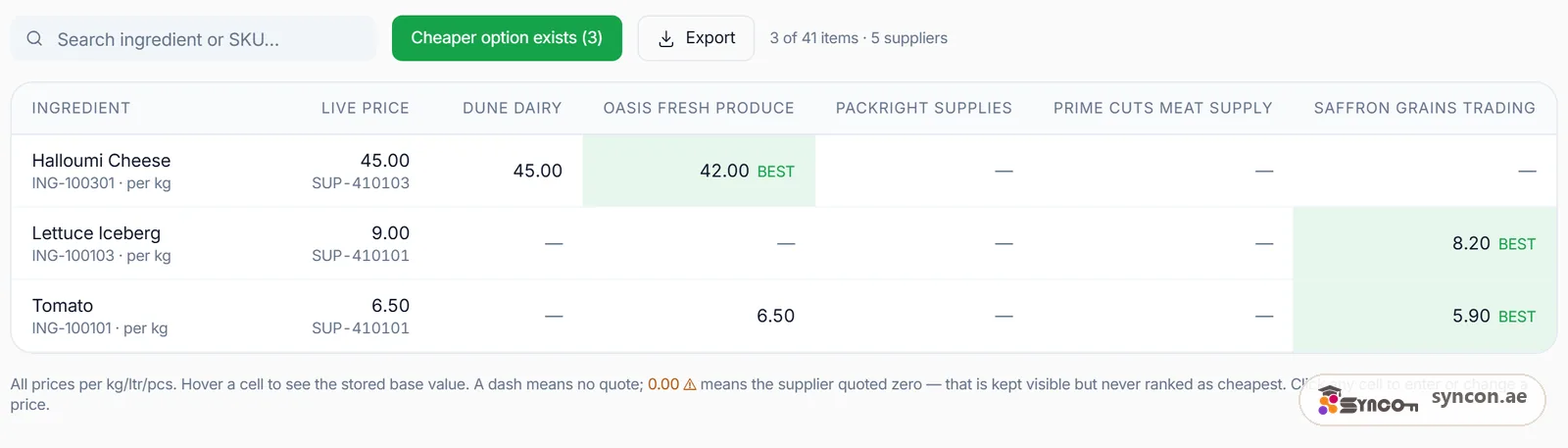
Suppliers quote per bag, per box or per carton, and the sizes are rarely the same. A price on a bag tells you what you pay today. It does not tell you what one kilo costs, and the kilo is what goes into your dishes. A bag that looks cheaper can hold less, so its kilo can be the dearer one. The quickest fix is also the cheapest one: put every quote in the same unit before you decide.
What good practice looks like
You can do all of this with a pen and a phone calculator.
- Write down the weight in the pack. For every quote, note what is inside the bag, box or carton, in kilos or litres. If the quote does not say, ask. A price without a weight cannot be compared.
- Divide the price by the weight. The result is the price of one kilo. Do it for every supplier on the same line, with the date you asked.
- Compare the kilo prices, not the invoices. The supplier with the lower bag price can easily have the higher kilo price. Only the kilo price tells you which one is cheaper.
- Multiply by what you really use. Take the difference per kilo and multiply it by the kilos your kitchen uses in a month. A small gap per kilo becomes a real amount over a month and a bigger one over a year. That number is what you take to the supplier.
- Check what else changes. A bigger bag can mean waste if you cannot use it before it spoils, and a cheaper kilo is no saving if half of it is thrown away. Delivery days and minimum orders belong on the same line.
- Repeat when a price moves. Re-do the sum whenever a supplier changes a price or a pack size. Pack sizes change quietly.
The aim is not to switch suppliers every month. It is that every time you choose, both options are measured the same way. If you want to see what happens when a price rises after you have already chosen, read supplier price increases: re-cost every dish. To keep a second supplier ready before you need one, see compare supplier prices before you need a backup.
Where the money is in the demo kitchen
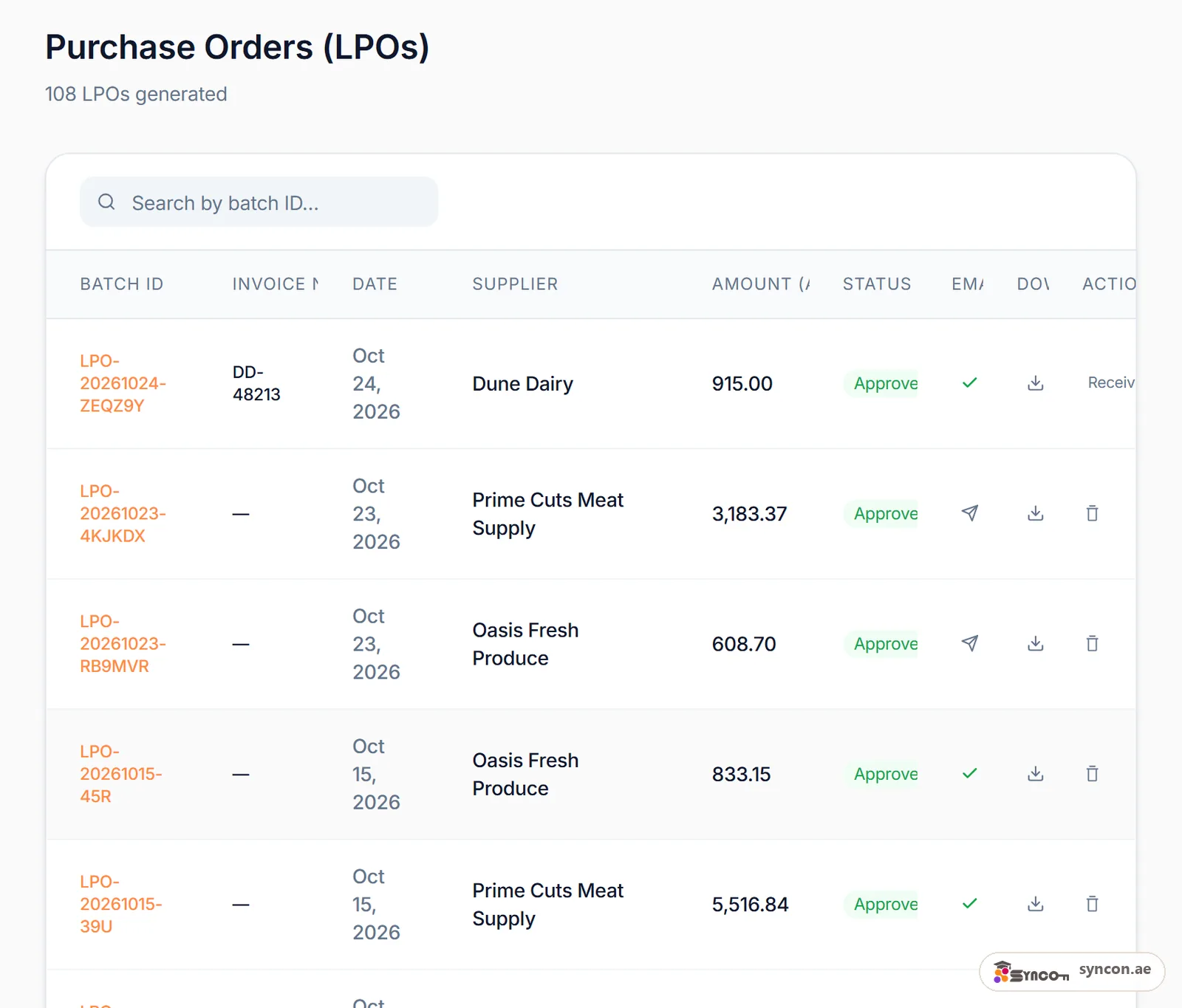
Look at how much sits with a single supplier. In October, the demo kitchen sent two orders to Prime Cuts Meat Supply: AED 3,183.37 on Oct 23 and AED 5,516.84 on Oct 15, together AED 8,700.21. On orders this size, a gap of even a few fils per kilo is real money, which is why the kilo price is worth the extra minute.
How this looks in SyncOn
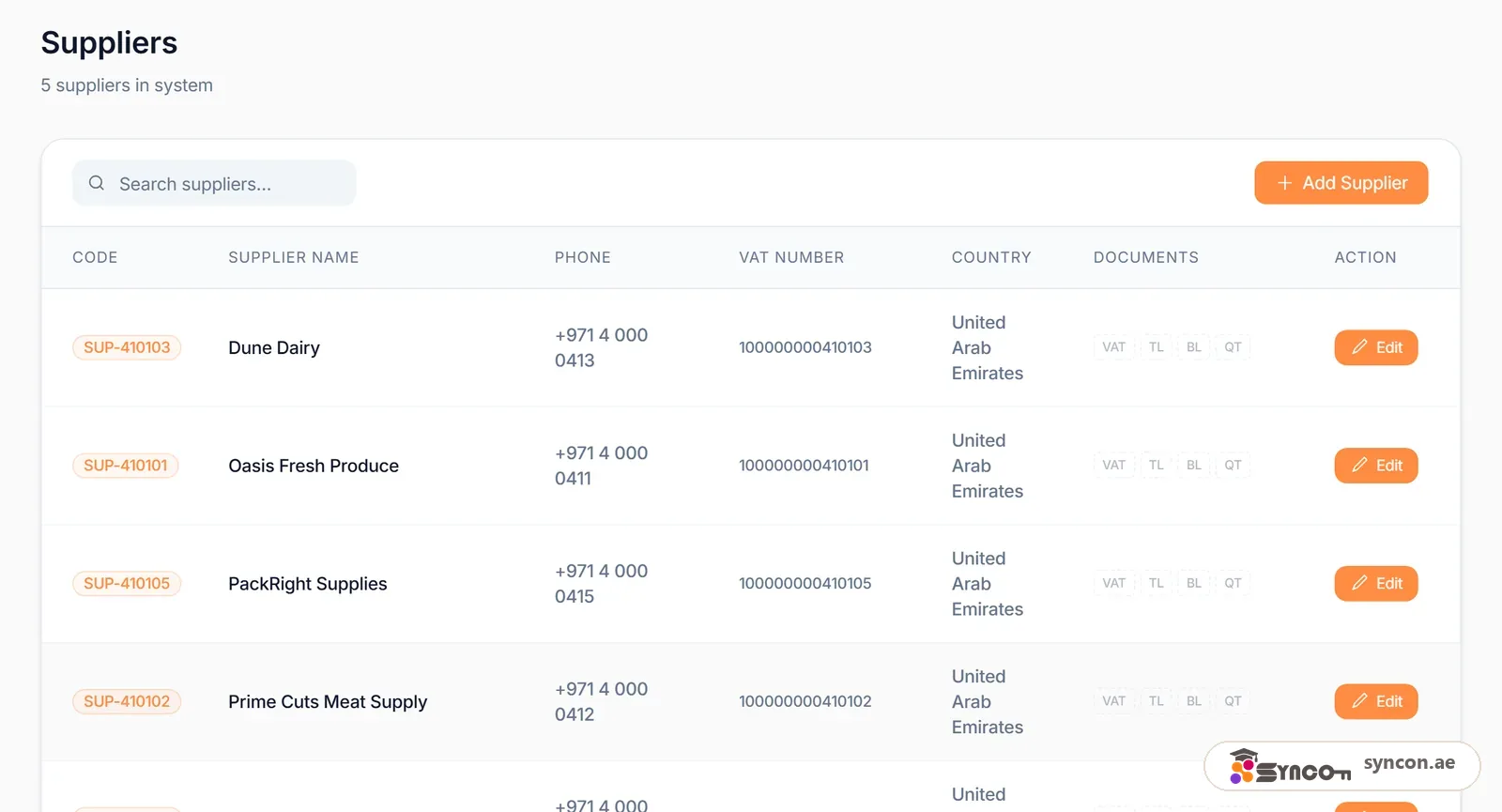
Start with who you can order from. The suppliers screen is one list for every branch, with each supplier's code, phone and VAT number. In the demo kitchen it says "5 suppliers in system": Dune Dairy, Oasis Fresh Produce, PackRight Supplies, Prime Cuts Meat Supply and Saffron Grains Trading. Every supplier you compare belongs on this list, with a complete record.

The Suppliers screen keeps that set in one place: when every supplier is on one list, the people comparing quotes are looking at the same set, and a supplier added on a quiet afternoon is ready when the next quote arrives.
Next, look at what you actually pay. The purchase orders screen shows each order by supplier, date, amount and status. The demo kitchen has 108 orders generated, and the first five show Dune Dairy at AED 915.00, Oasis Fresh Produce at AED 608.70 and AED 833.15, and Prime Cuts Meat Supply at AED 3,183.37 and AED 5,516.84.
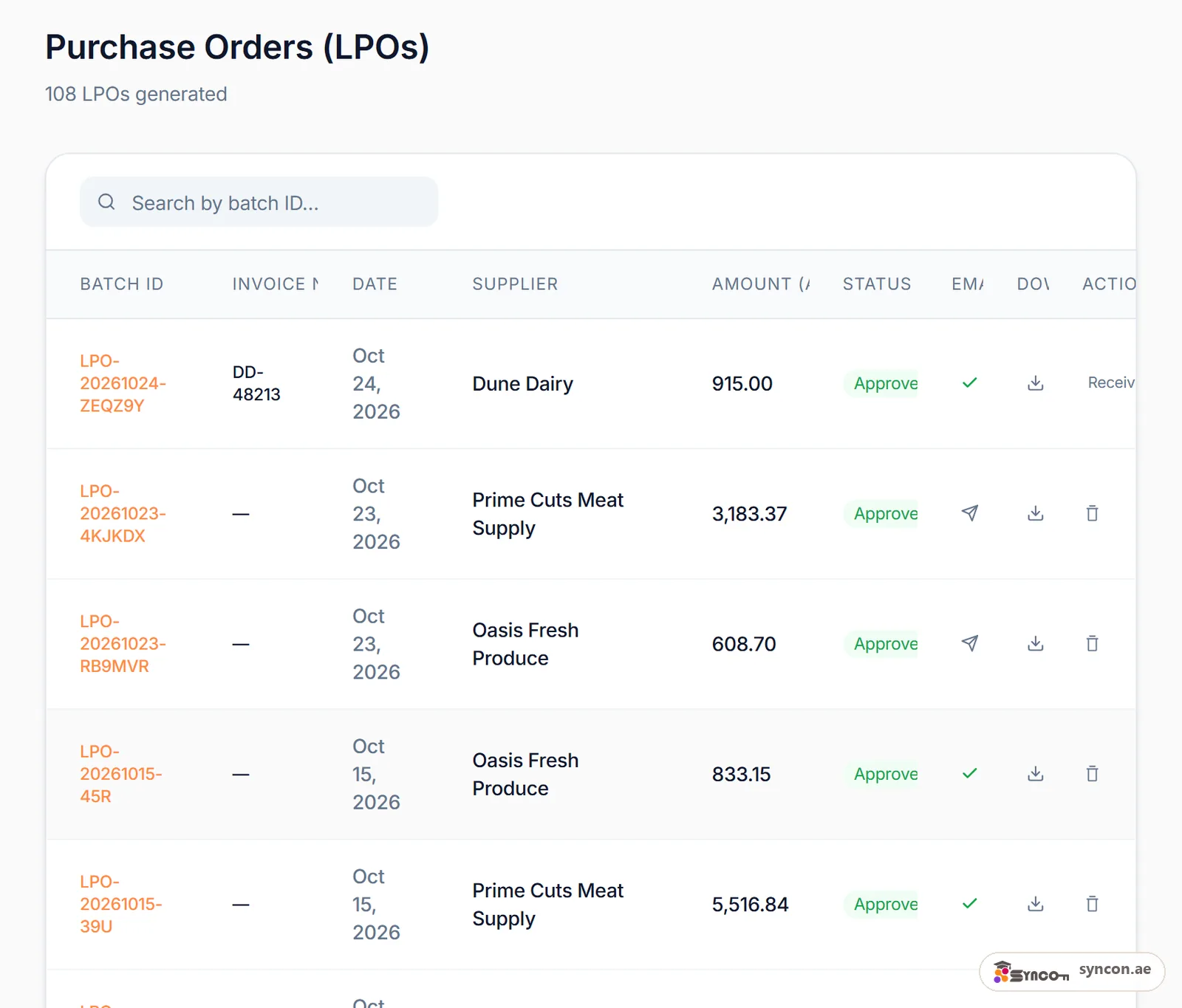
Read this list as the honest record of what each supplier is paid. Put the weight of what arrived next to each amount and you have the kilo price for your own kitchen, not just the one in a quote. Oasis Fresh Produce appears twice, AED 833.15 and AED 608.70, together AED 1,441.85. If those two orders were not the same size, only the kilo price can tell you whether the second was a better deal.
When the next quote arrives, open the list, find the supplier's last orders, and work out the kilo price before you answer. For the basics of keeping an approved list, see supplier management for restaurants.
Learn the full method in الشراء والنقد والرقابة.
The screens above are from
Restaurant operating systemsyncon.ae/portfolio/operating-system(opens in a new tab)