Restaurant KPIs to check every morning
The restaurant KPIs worth ten minutes every morning: sales against the average, orders against deliveries, and what the kitchen used.
SyncOn team · 21 Oct 2026 · 3 min read
Most restaurant problems are found late. The month closes, the accountant sends the report, and only then does someone notice that sales dipped for a week, a supplier delivered less than was ordered, or the kitchen used far more stock than the sales can explain. By then the money is spent and the chance to fix it has passed. A few restaurant KPIs, read every morning, change that.
Why it matters
KPIs, key performance indicators, are simply the few numbers that tell you whether the business is on track. The figures that would have warned you were there every day. Yesterday's sales, what was ordered and what actually arrived, how much stock the kitchen used: none of it is secret. It just isn't looked at until the end of the month, when it is history.
A short daily check turns those figures into early warnings. It doesn't need to be long or clever. What matters is reading the same few numbers, in the same order, every morning, until you know what a normal day looks like. Once you know normal, the unusual day jumps out by itself.
A fixed routine also spreads the work. When the same check is done the same way every morning, a manager can hand it to an assistant for a week and still trust the result, because the numbers and the order never change. The habit belongs to the business, not to one person's memory.
What good practice looks like
- Same time, same order, every day. Ten minutes before the first delivery, or with the morning coffee. A routine you keep beats a deep analysis you skip.
- Sales against the average, not against your hopes. Look at yesterday's sales next to the recent daily average. One quiet day is normal; three quiet days in a row is a question. The restaurant daily sales report covers how to read that line.
- Orders against deliveries. Compare what was approved for ordering with what was actually received. A big gap means deliveries are late, short, or not being recorded. A written restaurant purchase order for every delivery is what makes this comparison possible.
- Usage against sales. Look at what the kitchen consumed, in money. If consumption climbs while sales stay flat, check portions, wastage and recipes before the month ends.
- Read comparisons with the date in mind. Early in a month, this month so far will always look smaller than the whole of last month. Compare like with like, or simply note the date before you worry.
- Write down one action. Each morning, one thing to check or one person to talk to. Numbers only help when they lead to a conversation.
- Look at the trend once a week. Daily numbers are noisy. A weekly look at the shape of the last month shows whether things are getting better or worse, and a monthly look at the sales mix shows which dishes drive the numbers.
The aim is not to react to every small movement. It is to know your business well enough that a real problem is spotted in days, not weeks.
How this looks in SyncOn
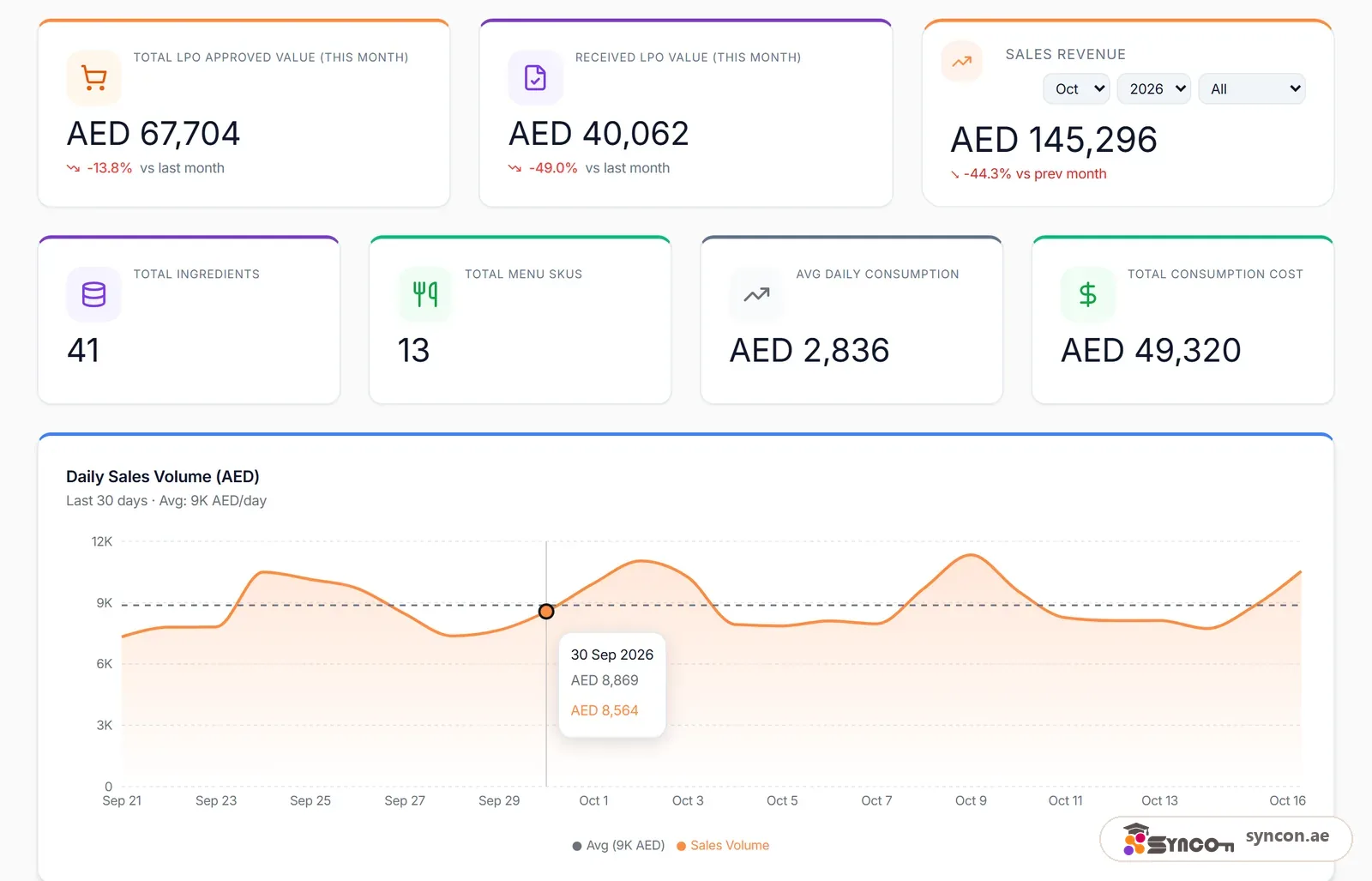
The dashboard puts the morning numbers on one screen. In the demo kitchen on 21 October, the top tiles show AED 67,704 of purchase orders approved this month, AED 40,062 of deliveries received, and sales revenue of AED 145,296 for October. Each tile compares itself with the month before, so with October only three weeks old the arrows point down, a good example of reading the comparison with the date in mind. Below them sit the total number of ingredients and menu items, the average daily consumption of AED 2,836 and the total consumption cost of AED 49,320.
The daily sales chart covers the last 30 days with a dashed line for the average, about 9K AED a day in the demo kitchen. Hovering over a day shows both values: on 30 September, sales of AED 8,564 against an average of AED 8,869, just under the line. Days well above or below that line are the ones worth a second look.
Learn the full method in التقارير والتخطيط والنمو.
The screens above are from
Restaurant operating systemsyncon.ae/portfolio/operating-system(opens in a new tab)